Technology2026-09-10
Product Based Companies in Pune: How They Build, Scale, and Grow Digital Products
Read Article
The technological landscape in 2026 is no longer defined by rapid experimentation; it is defined by practical execution, operational efficiency, and tangible ROI. Executive leadership teams are moving beyond the initial hype cycles of emerging tech to integrate enterprise-grade solutions that build market resilience and unlock business value.
Rajesh Sivalapan
Technology & Business Consultants
The technological landscape in 2026 is no longer defined by rapid experimentation; it is defined by practical execution, operational efficiency, and tangible ROI. Executive leadership teams are moving beyond the initial hype cycles of emerging tech to integrate enterprise-grade solutions that build market resilience and unlock business value.
CEOs and board members who fail to adapt their technology strategies risk operating with higher operational overhead, slower decision-making cycles, and legacy vulnerabilities that agile competitors will exploit.
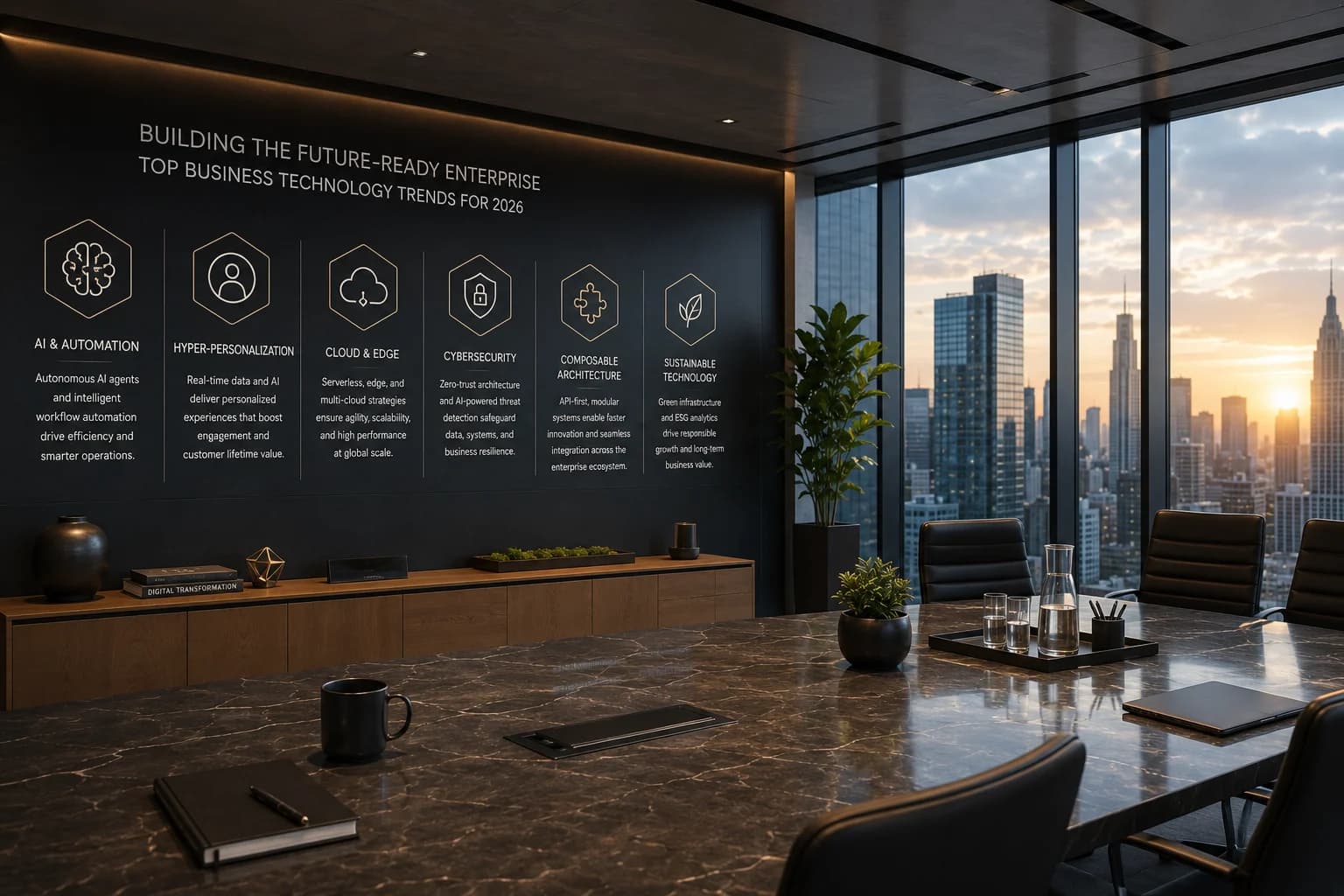
If you are refining your corporate roadmap for the second half of 2026 and beyond, here are the six major business technology trends driving modern enterprise transformation—and how to harness them.
| LEGACY BUSINESS OPERATIONS | MODERNIZE TECH STRATEGY (2026) |
|---|---|
| Fragmented data silos & manual BI | Autonomous AI agent workflows & real-time analytics |
| Cloud migration for basic storage | Cloud-native serverless & multi-cloud resilience |
| Reactive cybersecurity patching | Zero-trust architecture & AI-driven threat defense |
| Generic, static customer portals | Hyper-personalized AI customer experiences |
| Custom coding everything from zero | Composable architecture & API-first ecosystem |
| Isolated sustainability reporting | Embedded IT carbon & resource tracking (ESG) |
Generative AI has evolved from simple text and image generators into autonomous AI agents capable of executing complex end-to-end operational workflows. Rather than just assisting employees, these agents orchestrate multi-step processes—such as automated supply chain re-routing, financial reconciliation, and dynamic lead scoring—with minimal human supervision.
The Fix: Audit your core operations to identify high-volume, rules-based business workflows. Deploy specialized AI agents to automate lower-level operational tasks while establishing human-in-the-loop validation frameworks for critical strategic decisions.
Customer expectations have shifted dramatically. Generic marketing messaging and rigid decision-tree chatbots no longer convert. Modern buyers expect instant, context-aware interactions tailored precisely to their immediate intent and historical engagement data.
The Fix: Unify your customer data platforms (CDPs) with real-time AI analytics. Build hyper-personalized user experiences across website portals, mobile apps, and direct sales channels that dynamically adjust messaging, product recommendations, and support in real time.
Relying on a single cloud vendor or legacy on-premise hardware creates operational bottlenecks and vendor lock-in risks. In 2026, leading enterprises are adopting hybrid cloud strategies that utilize edge computing for instant, low-latency processing and serverless architectures to reduce infrastructure costs.
The Fix: Modernize legacy cloud workloads into serverless and microservices-based architectures. Utilize edge computing nodes to bring processing power closer to end users, ensuring sub-second response times and high system availability.
Cyber threats have become sophisticated, automated, and continuous. Traditional perimeter-based security models are obsolete in today's remote and hybrid work environments. Organizations are adopting Zero-Trust security models—operating on the principle of "never trust, always verify"—driven by real-time AI anomaly detection.
The Fix: Mandate enterprise-wide Zero-Trust access controls, multi-factor authentication (MFA), and automated AI threat detection systems. Conduct routine third-party penetration tests and security audits to safeguard proprietary IP and customer data.
Monolithic software suites make enterprise systems slow, rigid, and expensive to customize or upgrade. Forward-thinking companies are transitioning to composable architecture—building their technology ecosystems out of interchangeable, API-driven modules (MACH: Microservices, API-first, Cloud-native, Headless).
The Fix: Shift IT development budgets toward API-first architecture. Selecting modular software solutions allows your team to swap out outmoded components or integrate new third-party capabilities rapidly without disrupting core operational foundations.
As regulatory requirements expand and investor scrutiny tightens around environmental, social, and governance (ESG) metrics, green IT is now a board-level priority. Business leaders are evaluating the energy consumption of their data centers, cloud infrastructure, and software applications.
The Fix: Partner with cloud providers that run on 100% renewable energy and optimize application code to reduce unnecessary compute overhead. Implement automated ESG telemetry tools to track and report digital carbon footprints accurately.
Technology trends only create value when tied directly to core business outcomes—revenue expansion, operational margin improvement, and risk reduction. By focusing investments on autonomous execution, architectural flexibility, and proactive security, CEOs can position their organizations for market leadership throughout 2026 and beyond.
Focus on technology investments that deliver immediate operational efficiency or direct revenue impact. Prioritize high-ROI initiatives like workflow automation, legacy system modernization, and customer experience personalization before funding speculative long-term R&D projects.
The biggest risk is technology fragmentation—implementing isolated AI tools and cloud services without unified data architecture, governance, or security protocols. This creates data silos, escalates maintenance costs, and increases cybersecurity vulnerabilities.
Technological transformation requires equal focus on change management. Invest in continuous upskilling programs, establish clear governance guidelines for AI tool usage, and demonstrate how automation frees employees to focus on higher-value strategic work. Blog:
Rajesh Sivalapan is a Technology & Business Consultants at Maxima Business Solutions. Our team specializes in custom software development, cloud infrastructure setup, SEO strategy, and helping growing enterprises achieve operational excellence.
Partner with Maxima Business Solutions to build scalable architectures, modern web apps, and automated workflows.
Schedule Your Free Consultation